On 4 July 2026, the United States turned 250 years old - and it celebrated with what may be the largest gathering of tall ships and warships ever assembled on American waters. Sail250 brought dozens of square-riggers, barquentines and naval training vessels from more than 20 countries into New York Harbor for a parade that stretched from the Verrazzano-Narrows Bridge to the George Washington Bridge, watched by millions of spectators along a 15-mile waterfront. Here's a full breakdown of what Sail250 actually was, how the New York leg unfolded, and which ships took part.
What Was Sail250?
Sail250 was a five-city tall ship and naval tour organised to mark the United States Semiquincentennial - the 250th anniversary of American independence. Between May and July 2026, an international fleet of more than 60 vessels moved in sequence through New Orleans, Norfolk, Baltimore, New York and Boston, with free public ship tours and harbor parades at each stop. The tour drew on a long tradition: the original Operation Sail gatherings that marked the 1964 World's Fair, the 1976 Bicentennial, the Statue of Liberty Centennial in 1986, and the Millennium celebrations in 2000.
The New York leg - organised under the name Sail4th 250 by the non-profit successor to Operation Sail - was the centerpiece of the whole tour. It combined an International Naval Review with a Parade of Sail past the Statue of Liberty on Independence Day itself, and by most estimates became the largest maritime gathering in United States history.
Six Days on the Hudson: How the New York Program Was Structured
The Port of New York and New Jersey hosted festivities for six days, from 3 to 8 July 2026, combining warm-up parades, the main event, and a stretch of public ship-visiting days:
- 3 July - A Class B "warm-up" parade of roughly 25 smaller tall ships sailed down the East River from Long Island Sound, through Hell Gate, to anchorages in Gravesend Bay off Brooklyn. Brooklyn Bridge Park was the best vantage point for this preliminary parade.
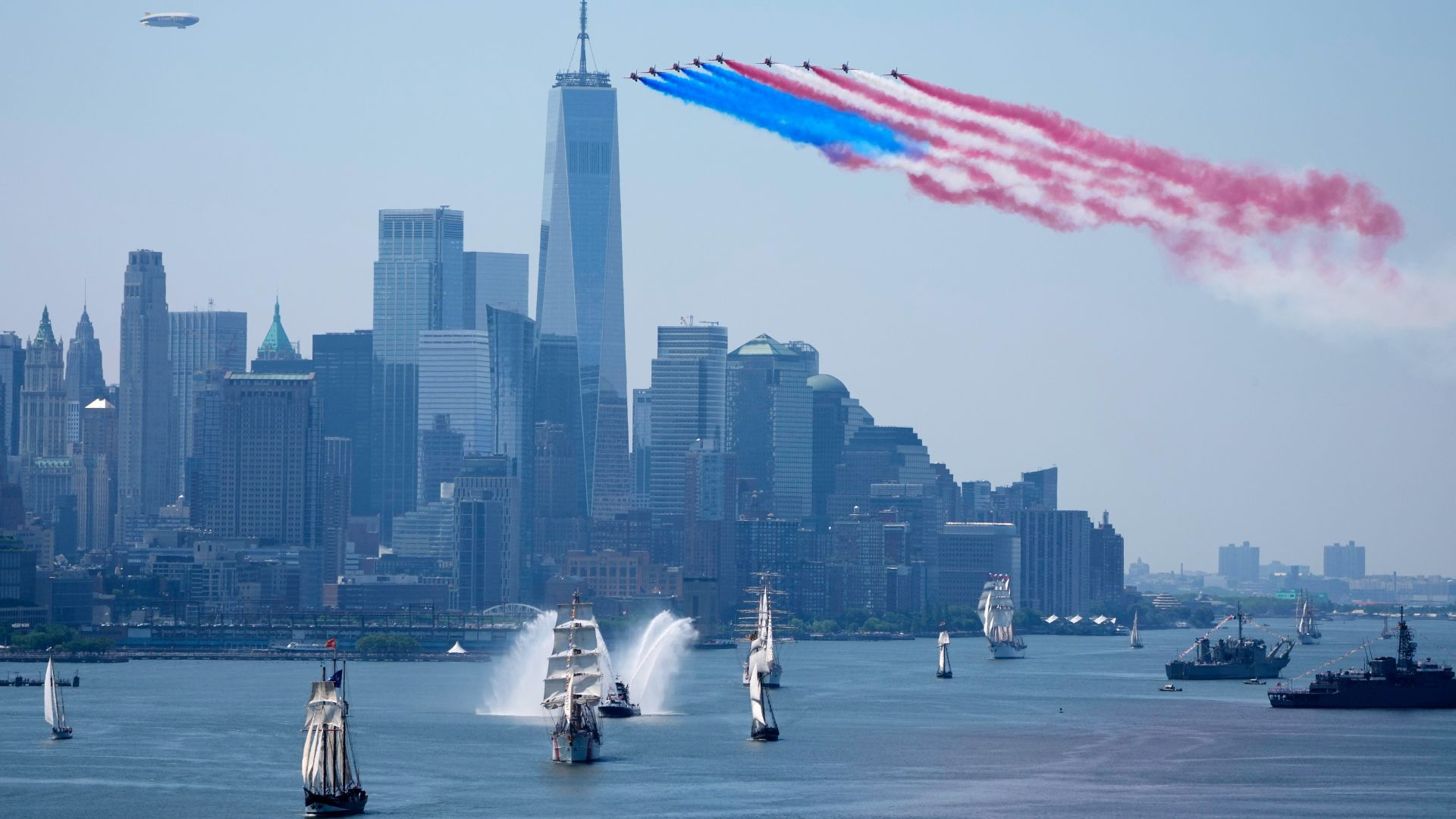
- 4 July - The main event: the International Parade of Sail, combined with the International Naval Review 250 (INR250) - only the seventh international naval review ever hosted by the United States, and the fourth held specifically in the Port of New York and New Jersey (following reviews in 1976, 1986 and 2000). More than 30 Class A tall ships, joined by the Class B fleet and roughly 40 grey-hull naval vessels, paraded from the Verrazzano-Narrows Bridge, past the Statue of Liberty, up the Hudson River to the George Washington Bridge, beginning around 9:30 AM. An aerial review flew overhead alongside the maritime parade, led by the Blue Angels and joined by international aerobatic teams including the French Air Force's Patrouille de France.
- 5-8 July - With the parade complete, the fleet dispersed to docking locations across Manhattan, Brooklyn, Staten Island and New Jersey - including Brooklyn Bridge Park, South Street Seaport, the Manhattan Cruise Terminal ("Sail City") and Staten Island's Stapleton Waterfront Park - for several days of free public ship tours.
Organisers estimated that around 8 million spectators lined the waterfront for the July 4th parade alone, with over 15,000 sailors from participating nations taking part across the full event.
The Fleet: Which Tall Ships Sailed in Sail250 New York
Sail250's New York leg brought together an unusually broad mix of naval training ships, most of them among the largest and most storied vessels of their kind still sailing. Some of the standout participants included:
- Esmeralda (Chile) - a 113-metre, four-masted steel-hulled barquentine of the Chilean Navy, one of the largest tall ships afloat, carrying a complement of around 300 sailors and 90 midshipmen.
- Juan Sebastián de Elcano (Spain) - Esmeralda's sister ship and near-twin, also 113 metres long, built in Cádiz in the late 1920s and one of the most travelled training ships in the world with well over 3.7 million kilometres logged in her career.
- USCGC Eagle (United States) - the US Coast Guard's iconic training barque, fresh off her Five Sisters Cup win earlier in the Sail250 tour, and one of four sister ships built to the same Blohm & Voss design as Gorch Fock, Sagres and Mircea.
- Gorch Fock (Germany), NRP Sagres (Portugal) and NS Mircea (Romania) - Eagle's three sister ships from the same class, all present in New York before continuing on to race each other off Cape Cod.
- ARC Gloria (Colombia) - a 65-metre barque and the official flagship of the Colombian Navy, carrying around 165 crew and cadets.
- Amerigo Vespucci (Italy) - one of the most recognisable training ships in the world and a fixture of major tall ship gatherings.
- ARA Libertad (Argentina), Dar Młodzieży (Poland), Guayas (Ecuador), Capitán Miranda (Uruguay), HMS Gladan (Sweden), Oosterschelde (Netherlands), Belle Poule (France), Juan Bautista Cambiaso (Dominican Republic), INS Sudarshini (India) and Tuiga (Monaco) - among more than 20 nations represented across the fleet.
- A handful of well-known American vessels - including Pride of Baltimore II, Elissa, Angelique and the schooner Lynx — represented the US beyond the Coast Guard's own Eagle.30 Class A and 30 Class B tall ships in the New York fleet, alongside some 40 naval vessels for the International Naval Review — plus high-profile guests such as a British aircraft carrier and Cunard's ocean liner Queen Mary 2.
Source: Eyewitness News
A Reunion Before the Race: Sail250's Link to the Five Sisters Cup
For sail training enthusiasts, one of the more interesting subplots of Sail250 New York was that it quietly set up a much rarer event just days later. Four of the five historic "Gorch Fock-class" sister ships - Eagle, Gorch Fock, Sagres and Mircea - were all present in New York before sailing on together to Boston, where they raced each other off Cape Cod for the Five Sisters Cup, a competition held only twice in fifty years. Gorch Fock went on to win that race as well, extending a winning streak that started with the very first Five Sisters Cup back in 1976.
Why Sail250 Mattered
Beyond the spectacle, Sail250 followed a tradition that stretches back more than six decades of using tall ships as informal ambassadors between nations - bringing naval cadets from dozens of countries together in one harbor, docking side by side, open to public tours, without any of the friction that usually accompanies international naval gatherings. For a country marking 250 years of independence, having ships built across three centuries - from a 1928 Spanish barquentine to modern sail-training platforms - sail past the Statue of Liberty together was as much a statement about international goodwill as it was about seamanship.
FAQ: Sail250
What was Sail250? A five-city tour of tall ships and naval vessels across New Orleans, Norfolk, Baltimore, New York and Boston in 2026, organised to mark the 250th anniversary of American independence.
When was the main Sail250 parade in New York? The International Parade of Sail and International Naval Review took place on 4 July 2026, sailing from the Verrazzano-Narrows Bridge to the George Washington Bridge.
How many ships took part in the New York leg? Roughly 30 Class A and 30 Class B tall ships, plus around 40 naval vessels, from more than 20 countries.
Where could the public see or board the ships? Free public tours ran from 5–8 July 2026 at Brooklyn Bridge Park, South Street Seaport, the Manhattan Cruise Terminal ("Sail City") and Staten Island's Stapleton Waterfront Park.
Is Sail250 connected to the Five Sisters Cup? Yes — four of the five historic Blohm & Voss sister ships (Eagle, Gorch Fock, Sagres and Mircea) were all present at Sail250 New York before sailing on to race each other near Boston.